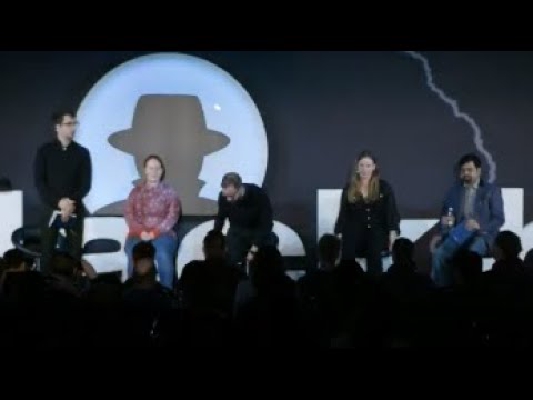
Locknote: Conclusions and Key Takeaways from Day 2
BlackHat 2022
08 December 2022
AI Generated Summary
AI Generated Content Disclaimer
Note: This summary is AI-generated and may contain inaccuracies, errors, or omissions. If you spot any issues, please contact the site owner for corrections. Errors or omissions are unintended.
This locknote (closing session) panel discussion from Black Hat Europe 2022 explores making the internet safer, community vs. industry, generalists vs. specialists, and centralization vs. decentralization.
Panelists
Federico Maggi: From Italy, academic who moved to industry 6 years ago, security researcher, Black Hat Europe Review Board member
Anant Shrivastava: Security researcher, Review Board member
Moderator: Ted (facilitator)
Key Topics Discussed
Making the Internet Safer - Personal Involvement:
Federico’s Perspective:
Question: “What can I do? To whom can I speak?”
Not policy making: Doesn’t see himself in policy making - not his strengths
Communication: Communicating with journalists, telling people stuff in easily accessible way
Teaching: Does teaching a lot - how to tell stuff to people in way they understand, even if non-experts
Effort: Means lot of effort - even at Black Hat, can choose to make talk accessible to beginners or skip introduction, go right to decision
One-to-one communication: What resonated from Jen’s talk - take time out of professional engagements, explain to colleague or two colleagues why certain thing is security relevant
Most ubiquitous way: One-to-one communication at workplace is much more applicable to reality
Everyone can do it: Don’t have to be good trainer to suggest colleague to do this and that
Anant’s Perspective:
Responsibility: We all have responsibility to educate those around us
Most significant changes: Fed down through policy
Important: Not just about us as individuals, but having conversation with policy makers
How we change security: Fundamentally for everyone - through policy
Powerlessness and Middle Position:
Frustration: “We’re sort of powerless, we’re kind of in the middle”
Two directions:
Top down: Regulation, act of the state
Bottom up: Person or company closest to levers of power (Apple, Microsoft, Google)
Reality: “A lot of things will never get better unless Apple or Microsoft or Google makes them better”
Problem: Can invent every product in world to put on top of operating system, but unless operating system improves, we’re standing still
Stuck in middle: Don’t create policy/regulation, and unless on development team at Microsoft/Facebook, it’s not getting better either
Get all the arrows: “Oh the security Community you can’t fix anything” - but not at Microsoft fixing the thing
Oversized expectations: Might have oversized expectations for what we’re capable of
Not our fault: “It’s not my fault that Facebook can’t fix their two-factor authentication”
Accepting arrows: Setting ourselves up for disappointment, accepting inbound arrows that don’t belong to us - should go toward manufacturers
Getting to Manufacturers:
Incentivize internally: How to get there to manufacturers? Incentivize internally to the good
Naming and shaming: Some successful campaigns around naming and shaming
Prioritization: “How come this feature or company is prioritizing 50 different things?” - influence them to prioritize number 23, make it number 5, gets fixed sooner
Don’t feel guilty: When there’s another outbreak, work harder to try to convince them to improve security
Security Industry Problem - Admiring the Problem:
Cynical by nature: Nature of job makes us cynical
Problem: “We only point flaws, we keep finger pointing - this is wrong, that is wrong, that is wrong”
Never have solutions: “We never have solutions, we are never on the table to discuss the solution”
Exception: Unless you’re the developer on the team at the company
Reality: “We’re just admiring the problem”
Breaking and forcing: Breaking and forcing them to fix is something that actually moved the needle (unfortunate)
Building Solutions:
Twitter example: Problems there, people found things not working, they built Mastodon, built ActivityPub, kept experimenting
Security industry needs: Build solutions, build some POCs, put them forward, focus on solution aspect rather than just (because that pays the mortgage)
Incentive problem: “There isn’t an incentive to build” - unless you have goodwill in your heart
Quote: “You’ll never convince a man as long as his paycheck is tied to not understanding the problem”
Incentives and Nudging:
Skepticism: Skeptical about incentives - used to be big believer
Insurance company theory: Thought insurance companies would provide economic incentives - companies choose better product, get lower rates, do economically rational thing, consumers buy safer product (like Volvo with airbags)
Reality: That never happened
If not insurance and not rational consumers: Who are we nudging?
Now: Nudging regulators, policy makers to do things we can’t do
Problem: “We’re pursuing nudging, we just keep changing the audience”
Exhausted options: Trying to nudge everything possible, trying to put stick everywhere, whatever works - exhausted lot of options, not much progress
Policy could be way: Seen happening with GDPR, bunch of other policies - could be way to move forward
Conversations with Software Engineers:
Question: “Do we have good conversation with software engineers?”
Remember: Each of us who worked as security researcher or vulnerability researcher remembers having good productive conversation with software engineer
Help them understand: What could be good consequences, what happens when their software gets abused
Incentive model problem: When you have giant hyperscalers like Google, their incentive model is to reduce network latency, more interactivity
Result: “We’re not going to do certificate pinning, we’re not going to do DANE, what we’re going to do is certificate transparency”
After the fact: “After your horses have run out of the barn, we’ll tell you your horses are out of the barn with certificate transparency - after you’ve already suffered the harm”
Data collection: Lot of data to collect, they can analyze it, get telemetry, study the web
Small business perspective: “As a small business, I want the barn door to be very secure and stay closed - I like certificate pinning, I like DANE, I like all the things that Google didn’t like because it was cumbersome or slower or didn’t give them the analytics they wanted”
Outsized weight: Because they have so much outsized weight and they have Chrome, they just throw out what they don’t like, throw in what they do like
Not necessarily more secure: “That’s not necessarily what’s more secure, but what’s better for them”
Little person: “As the little person, we don’t have that much influence”
Community vs. Industry:
Job Market Survey:
Looking for job/change jobs/hiring: Very few
Totally happy, not looking to move: More, lot more happy where they’re at than looking to turn
Community Focus:
Black Hat, Defcon, Chaos Computer Club, Bsides: Community focused
Doesn’t pay mortgage: Community doesn’t necessarily pay your mortgage
New people: Come into industry through television or read book - “I can get paid, it’s paying well, stocks are growing”
Not for community: Don’t necessarily come for community or to comment on latest legislation
Come to make money: Make money, grow their family
Question:
Problem: Do we have problem socializing people into “the community”?
Normal: Is this normal? Like automotive makers - people passionate about making automotives, people just there to assemble thing and go home
Worry: Is this thing we should worry about?
Perspectives:
Motivation question: “Will it still motivate and drive creativity, critical thinking, or push individuals in slightly different direction?”
Common pattern: This is common pattern across every industry - people passionate about things, people there to do the job
Doesn’t mean not creative: Doesn’t necessarily mean they won’t be creative - they’ll be creative between 9 to 5, they’ll switch off, go back home, live life with kids, family
Reality to accept: If industry needs to grow, if we keep talking about skill shortage, resource shortage, if want to fill that gap, we need people who are here to work
Don’t care about community: Lot of them would not care about how good community is or even if community exists - they don’t care about it, they’re here to do the job, they’ll do the job, they’ll move on
Should not be hostile: “We should not be hostile towards that attitude if you want to keep moving forward, keep growing forward”
Reality: Some of us are passionate, not everyone is, and that’s fine
Mentoring Experience:
50/50 split: Italian students who want to go abroad
50%: “What’s the fastest way to get into security and find good internship in top tech company”
50%: “Tell me what you do, why you like your job”
Same answer to both: “Try to look around the community, try to orient yourself into what we do, into what conferences”
Results:
50% with open mindset: Keep going with open mindset
50% who came for internship: Another half stick to asking for internship, maybe 25% convert them into thinking first about what they really want to do
Historical Parallel - Ad Industry:
Early days of internet cybersecurity revolution: Big split between people professionally creative and naturally creative
Ad industry (40s/50s America): People who would create advertisements because they were great at it, then it became industry - had to be professionally creative every day
Same with hackers: People at incredible exploitation or understanding but can’t do that every day - not their thing
Split: Between “the sellouts” - anti-sec movement, “oh you’re a commercial infosec sellout, you’re doing that to get paid, you’re not doing it because that’s what you love”
Bad attitude: Now long gone
Reality: Some people can only be creative in coding when it suits them, other people can sit down grind it out for eight hours a day
Burnout: People who are creative especially because they’re limited to eight hours - will burn out when do over hours for too long
Not everyone: “Everyone who says I want a nine-to-five job is not also loving their job”
Generalist vs. Specialist:
Audience Survey:
Generalists: Some
Specialists (e.g., “IDA Pro Ninja”): Close to equal, maybe few more generalists
Historical Perspective:
Longest time: Generalists were dying off, all the money was in specialization
Paycheck control: How deep, how far you could get, how well you understood the technology really controlled your next paycheck
Generalists outclassed: Could never get that deep
Changed: “I think that’s changed”
Current View:
LinkedIn comment: Person looking for job, toning down aspect of being generalist, saying “I feel myself as a generalist, I’m good for those hard to fill positions”
Not negative: “I don’t think is negative aspect at all”
Much needed: “Having deep generalists in key positions now is much needed because we have good specialists, we’ve been having good specialists, now we need to sort of glue them together in a strategic way”
Research Talk Reference:
Idea: You can either be generalist or specialist
Specialist position: Pinpointed focused - does not mean going to run the entire thing
To run entire company: Not only need pinpointed focus, need generalists
More than ever: Need more generalists around
Generalist is way: People should be looking for
Other angle: Including part about working nine to five, investing time in other things
Creative process: Can also draw inspirations which are not from infosec world
Examples: Do gardening, do something else - that can give you inspiration to do better job in current work area
Being generalist: Being able to explore other areas could be another good thing - not something you should not be doing
Surprise:
Surprised at audience response: Know plenty of people that have shifted slightly throughout their career
Surprised: So many people who said “I’m a specialist”
Question: “I wonder whether if they look at their career, whether they have done different versions of a thing and therefore also have this broader skill set”
Follow-up: “How many people have been doing the same specific area of work throughout their career?” - 2-3-4 people
Centralization vs. Decentralization:
Centralization Benefits:
Economies of scale: Get efficiencies, one spot to monitor
Example: Russia invaded Ukraine, Ukraine has certain infrastructure on Microsoft - Russia now has to battle in Microsoft’s territory
Great: Those economies of scale in centralization for their infrastructure
Centralization Problems:
Convenient places to be regulated: When everybody ran mail server, harder - if there’s like five dominant mail servers and they get some order to filter, nobody can ever send email to China or something
Convenient for regulation: Centralization breeds what lawyers would call “attractive nuisance” - very attractive to regulate it
Internet History:
Began decentralized: Economic models forced centralization
Hope for decentralization?: Thing people point to is DNS, but look at what’s happened there - Quad 1, Quad 8 - it’s centralized again
Even time services: Are centralizing
Question: Should we get over that? Should we stop telling these myths of internet being designed to withstand nuclear war? Or should we actively be trying to create more decentralization?
Perspectives:
Federico’s View:
Hacker in me wants decentralization: Want people to have autonomy over their data and over their servers
Internet speeds: Have gotten so great that benefits of centralization have decreased to point where it’s less noticeable
Olden days: Was very noticeable, but maybe we’re fast enough now
Multiple angles: Internet speed has increased, gave more access to people, resources more prominently available
Not everyone: Don’t expect everyone in world running their own - that’s impossible
Technically capable: People who are technically capable - running web server from your home on Raspberry Pi is not problematic affair
Spend few hours: Can get things moving, exploration
Creative aspect: Whole creative aspect that could be the input
Indie Web: Whole idea about setting your own websites, having your own blog, not being controlled by central authority with whole moderation
Excites me personally: But it’s dangerous - if forget to apply security updates, might lose your data
Choice: Can now choose - do I give all my data to Microsoft/Google/Apple, or do I host it on my own and now have to check every day “is there a security update, have I been breached, is my data now with the big companies but did it not get to anyone?”
Maybe: If more people self-host, will auto-check for updates faster
Cynical angle: “It’s the cynical in us which says hey I’ll get hacked, I’ll get compromised, things are going to go bad”
When centralizing: “Are we 100% sure things are not going bad there?”
Examples: Cloud service providers with whole responsibility were running like five-year-old software
Not just moving responsibility: “It’s not like just moving the responsibility on the other side is just going to cover everything”
Moderator’s View:
Romantic idea: “I am a sucker for the Grassroots Uprising” - could be from reading Shockwave Writer or Neuromancer or whatever
Early days: Very kind of romantic - power of the individual
Early days contributions: Individuals made the largest contributions, the breakthroughs
Cypherpunks: Movement of punk cryptographies in Bay Area that really moved the needle on privacy and anonymity
Died out: As .com bubble grew, they got jobs, things became more commercialized
10 years ago conversation: “I want to cause some chaos, what can I do as an individual? Can I run a remailer? Do I run Tor nodes?”
Response: “You know everything’s done in teams now, you need like a team of people to develop the software”
Depressing: “The time of the individual making a big contribution to privacy of security is kind of over” - really depressed for about 3-4 years
Realization: “No they’re wrong - some of the contributions are still being made by the individuals by individuals”
Much harder now: To just do your own, and it’s more based on luck - “I think you’re sort of at the right place at the right time when people need that thing that you’ve built”
Mastodon Example:
PR part: Mastodon existed, got the PR when some other disaster happened (Twitter mismanagement)
People were working on it: It’s not like no one else was working on it - work was going on, it was not promoted, it was not publicized
Mastodon: Most popular version of federated service on ActivityPub protocol
Been around: For 5 years, only until somebody starts mismanaging Twitter, waves of people look for alternative, Plan B
There it is: Plan B, all of a sudden they have their moment
For 5 years: They were not definitely not having their moment - neither they were interested in promoting it, nor anyone else was interested or incentivized to actually talk about it
But they kept working: Despite that, they were still working because they liked working on it
Now: Gonna have like 3 years of development in the next 6 months - gonna get so much attention
Future of Decentralization:
Dawning of movement?: Is that then the dawning of potential movement toward decentralization?
Somebody will improve: Some VCS and the value will say “I’ll do a better job”
Or one-off mutation?: Is this just like the one-off weird mutation, then we’ll go back - when next person who runs Twitter, we all go back to our centralized ways when next person buys Facebook or LinkedIn
Concerns:
Worry about centralization: Around DNS, around RPKI, or the holders of the keys that control RPKI
Trade-off: There’s the trade-off and there’s the regulation
Question: “What can hackers, what can we get, what can we do for our own Plan B, or do we just say you know what there’s no more Plan B, we’re just on whatever”
Solution:
Keep making efforts: Like said about Mastodon - need to keep making efforts or the entire ActivityPub because there’s so many softwares around it
Incentive or internal incentive: Comes into picture - if you feel that you have something that’s different, work on it
Mastodon’s Difference:
Lack of algorithm: Interesting thing with Mastodon is there’s lack of algorithm
Twitter/social media: Optimized to generate interactivity - that algorithm is missing
What happens: With it missing, how do people behave differently?
Not race: It’s not a race to get maximum likes, it’s not constructing attractive post that gets you most retweets
It’s different: Downside though is there’s no monetization, there’s no influencers, there’s nobody to get paid, there’s no way for administrators of these servers to get paid yet
Feeling: “I have a feeling we’ll see if a decentralized model can work, we’ll see introduction of some monetization”
Server operators: Can get paid - not getting paid means there’s million teeny instances
If can get paid: They’ll be larger, better, more professionally run instances
If can monetize content providers: Somehow then you have professional creatives coming in, more likely to share
If can do that: Without the toxicity of the algorithm, then I think you have a viable thing
Incentivizing Administrators:
Like to see: Something that incentivize administrators of Mastodon nodes to host good services
Now: They’re not getting paid essentially, they do it for free just because they want
Another spin: On monetization aspect is not only on content production aspect but also on platform and infrastructure management
Community Service Providers:
Question: “Who here runs any kind of service?”
Examples: Defcon runs Tor nodes, runs a forum for over 20 years
Who runs something: That helps the community? ~20 people
Thank you: “Thank you for that, everybody who’s taking advantage, give them a round of applause”
Way forward: “I think that’s the way forward - the people who want to can provide the services”
Key Insights:
Security community is in middle - don’t create policy, not at manufacturers fixing things, but get all the blame
We admire the problem - point flaws, never have solutions
Need to build solutions, not just point problems
Community vs. industry - need both, shouldn’t be hostile to people just doing the job
Generalists needed more than ever - to glue specialists together strategically
Decentralization possible but requires effort - Mastodon example shows it can work when right moment comes
Monetization needed for decentralized services to be sustainable
People who want to can provide services - that’s the way forward
Important Concepts:
Certificate Transparency: Google’s approach - tell you after horses have run out of barn
Certificate Pinning/DANE: What small businesses want - secure barn door
ActivityPub: Protocol for federated services
Mastodon: Most popular federated service
RPKI: Resource Public Key Infrastructure
Quad 1, Quad 8: Centralized DNS services
Actionable Takeaways:
One-to-one communication at workplace is most ubiquitous way to raise security awareness
Have conversations with policy makers - most significant changes fed down through policy
Don’t just point flaws - build solutions, build POCs, focus on solution aspect
Don’t be hostile to people just doing the job - need both passionate and job-focused people
Generalists needed to glue specialists together strategically
Keep working on decentralized solutions even if not getting attention - right moment will come
Run services that help community if you want to - that’s the way forward
Monetization needed for decentralized services to be sustainable
Don’t accept arrows that don’t belong to us - should go toward manufacturers
Focus on building solutions, not just admiring the problem