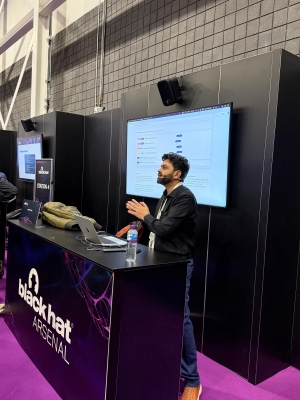
SBoM Play was demonstrated at Black Hat Europe 2025 Arsenal. The Cyfinoid Research open source platform takes a GitHub organization, user, or repository URL and turns it into an in-browser exploration dashboard, running fully client side with no backend, covering dependency analysis, vulnerability tracking, license compliance, author attribution, geographical distribution, and version sprawl.
Summary
The opening slides defined the tool: SBOM Play is an SBOM exploration and intelligence extraction platform, in-browser and fully client side. The creation idea slide explained the motivation: an SBOM is just an inventory, the interesting part is using it in non-infosec scenarios, and showing is better than talking.
The input model got a full slide to itself: one field, as simple as it can get. A user enters a GitHub organization, user, or repository, either in short form (user/repo, org/repo, a username, or an org name) or as a full GitHub URL such as https://github.com/cyfinoid/sbomplay. The only requirement, noted as a postscript, is that the GitHub Dependency Graph must be enabled on the target repositories.
Under the hood, the tool fetches dependency graph data through GitHub’s API, creates nested SBoMs by recursively resolving dependency trees, and correlates everything on the client side. The demo then walked the dashboard views one by one: the 10K feet dashboard for a high-level look, the dependency view for drilling into packages, the vulnerability view for known issues across dependencies, the repository view for per-repo dependency health, license compliance, license change tracking between versions, author details, the geographical view of dependency author locations, and version sprawl for spotting multiple versions of the same package across repositories.
The “beyond vulnerabilities” positioning closed the technical story: the tool deliberately goes past vulnerability scanning into license risk, author trust, geographical concentration, version inconsistency, and organizational dependency patterns, presenting SBoMs as strategic intelligence rather than a compliance artifact. The closing slide shared the live URL at cyfinoid.github.io/sbomplay and the source at github.com/cyfinoid/sbomplay.
Key Themes
- Tool philosophy and design: an SBoM is fundamentally an inventory, and the value lies in extracting intelligence from it; the tool argues its case by showing, including non-infosec scenarios, rather than by theoretical argument.
- Simple input model: a deliberately minimal one-field interface accepting a GitHub organization, user, or repository in short form or as a full URL, lowering the barrier to entry.
- Under-the-hood processing: dependency graph data fetched via GitHub’s API, nested SBoMs built by recursively resolving dependency trees, all processed on the client side.
- Dashboard and visualization capabilities: a 10K feet overview plus dependency, vulnerability, repository, license compliance, license change, author details, geographical, and version sprawl views.
- Beyond vulnerabilities: license risk, author trust, geographical concentration, version inconsistency, and organizational dependency patterns position the SBoM as strategic intelligence rather than a security compliance artifact.
Notable Points
- Live URL: https://cyfinoid.github.io/sbomplay/; source code at https://github.com/cyfinoid/sbomplay/.
- Input accepts a GitHub organization, user, or repository in short form (user/repo, org/repo, username, org) or as a full GitHub URL such as https://github.com/cyfinoid/sbomplay.
- Only stated requirement: the GitHub Dependency Graph must be enabled on target repositories.
- The tool is in-browser and fully client side, with no backend or server; privacy is preserved because data is fetched from GitHub’s API and processed locally.
- Nested SBoM creation resolves dependency trees recursively rather than stopping at one level.
- The demo sequence covered nine views: 10K feet dashboard, dependency view, vulnerability view, repository view, license compliance, license change, author details, geographical view, and version sprawl.
- License compliance and license change views catch licensing risk before it becomes a legal problem, which matters for organizations with strict open-source policies.
- Version sprawl detection surfaces multiple versions of the same package across repositories, and the geographical and author views support geopolitical and single-maintainer risk assessment; enabling the Dependency Graph organization-wide makes repos accessible to this class of tooling.
Notable Quotes
“SBOM Exploration and intelligence extraction platform”
“SBOM is just an inventory”
“Showing is better then talking”
“One Field : As simple as it can get”
“P.S. We just need Dependency Graph enabled on repositories.”