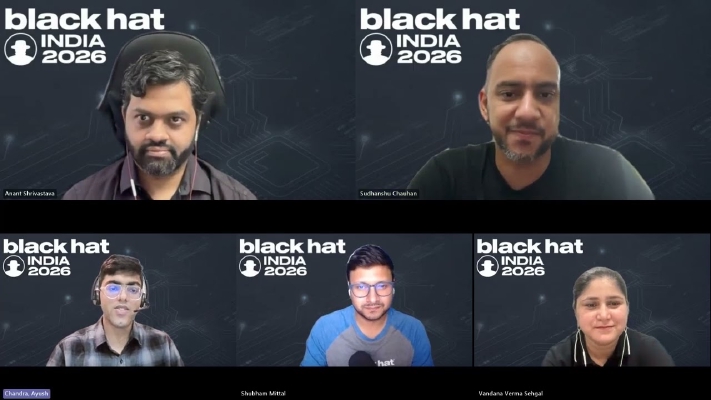
A roughly 32-minute launch podcast for the first-ever Black Hat India, coming to Bangalore on October 27, 2026, brings together four members of the event’s Briefings Review Board: Anant Shrivastava (founder, Cyfinoid Research), Vandana Verma Sehgal (Snyk), and Redundant Labs co-founders Sudhanshu Chauhan and Shubham Mittal. The host introduces the board as the people who will read every submission, debate every talk, and ultimately decide what lands on stage at Black Hat Bangalore, holding the India edition to the same standard as any Black Hat worldwide. The conversation covers why Black Hat chose India now, what the board looks for in a Briefings proposal, where Indian security research thrives and where it is held back, and which tracks, from fraud and FinTech to AI, supply chain, and OT, the board most wants to see. It closes with a direct appeal to first-time researchers who doubt their work is ready for a global stage.
Summary
Black Hat has run events in Las Vegas, London, and Singapore for decades; this October it lands in Bangalore as the first Briefings experience in South Asia. Anant framed the move as removing a barrier: the flagship events were always far from India, and a home-ground stage gives Indian researchers a reachable venue, while hallway conversations and community areas deliver the unconference payoff of concentrating talent in one place.
Most of the episode coaches prospective submitters. Novelty first: a paper should not be easily available, and work done hundreds of times will not get a stage. Responsibility next: no talk highlights a CVE before the vendor fixes it. Submissions need a story in a concise two to three paragraph abstract, a genuinely detailed outline, and clear takeaways, which the board finds missing in many talks. Proof beats prose now that anyone can generate a polished abstract with AI: leave it to reviewers to find the evidence and you have failed, and machine-written submissions are recognizable from a distance. The picky board enforces vendor neutrality, so stating what your company sells and how the talk avoids becoming a pitch builds trust, and reviewers under NDA expect full technical details.
On disclosure, Vandana’s baseline is submitted, fixed, and communicated before the stage, with methodology discussed where vendors are uncomfortable. Anant framed disclosure around the end user: publicizing an unfixed bug harms users, and where a vendor has stonewalled for a very long time the board may still accept the talk, depending on severity, to make the community aware.
The board mapped India’s landscape: world-class application and mobile talent, but hardware, IoT, and OT work constrained by cost and access, since testing WordPress needs a laptop while IoT research is an investment. Wanted tracks include fraud and FinTech abuse, internet scanning, UPI-scale payments and critical infrastructure, and AI in both directions: horizontal AI research plus security of AI itself, where teams run agents with little observability, along with shadow AI and AI bill of materials work. Anant asked for cost-aware angles (CVEs found for $3 rather than $500) and warned about AI psychosis in submissions, hoping Indian researchers deliver talks that force the board to go research what they just read. The closing appeal targets the tier-2 researcher nobody has heard of: submit, because if the work is as good as you think, you will be on stage in Bangalore.
Key Themes
- Black Hat comes to India: The first Black Hat in South Asia removes the travel barrier that kept the flagship events out of reach for much of the community, and adds the hallway-conversation payoff of concentrating talent.
- The winning proposal recipe: Novelty, responsibility, a concise story in the abstract, a genuinely detailed outline, clear takeaways, demonstrable proof, and vendor neutrality beat polish every time.
- Proof over AI-polished prose: Machine-generated abstracts are recognizable, and reviewers expect evidence up front rather than being asked to find it themselves.
- Responsible disclosure with the end user first: Stage only fixed vulnerabilities and say so; where vendors stonewall, the board may still stage the talk to protect users.
- India’s research gaps: Hardware, IoT, and OT research lags because equipment and access cost real money, and the field needs more research, more access, and more facilitation.
- Wanted tracks: Fraud and FinTech, internet scanning, UPI-scale payments, supply chain, security of AI agents, and AI research with a genuinely new, cost-aware angle.
- Submit anyway: Ratios run 10:1 to 20:1, reviewers are under NDA, rejection is not a verdict on quality, and feedback can be requested.
Notable Points
- The debut Black Hat India runs October 27-30, 2026 in Bangalore, with the call for papers open at the time of the episode.
- The Briefings Review Board features Anant Shrivastava (about 18 years in technology, roughly 15 in information security, founder of Cyfinoid Research), Vandana Verma Sehgal (around 19 years in cybersecurity, at Snyk, already on the review boards for Black Hat Asia, Europe, and US), Sudhanshu Chauhan (over a decade in offensive security, Redundant Labs co-founder, long Black Hat history across Arsenal, trainings, and review boards, co-runs Recon Village at DEF CON), and Shubham Mittal (around 15 years in security, Redundant Labs co-founder, runs Recon Village and the Indian Hackers Club).
- One-word hopes for the event: more exciting research (Anant), deep technical (Vandana), community (Sudhanshu), and cool hacks plus networking (Shubham).
- Anant described hallway conversations and community areas as the unconference that happens within every conference.
- Reviewers operate under NDA, so submissions should include full technical details, and anything shared stays inside the review circle.
- Sudhanshu’s relevance observation: talk relevance windows have shrunk from a year to roughly three months in the AI-accelerated world.
- Sudhanshu distinguished security using AI from security of AI, flagging teams that run agents and fine-tuned LLMs with unclear access, undefined permission models, and weak guardrails.
- Vandana pushed for research on AI bill of materials and shadow AI, contesting claims that OWASP’s LLM, agentic, and MCP Top 10 lists ended the shadow AI problem.
- Shubham called fraud and FinTech under-discussed despite massive impact, named internet scanning an all-time favorite, and answered 100% on UPI-adjacent startups and e-commerce having researchers who should submit.
- Anant noted India has yet to produce a Pwn2Own champion and asked for non-AI research too, including supply chain, hardware, IoT, and CPS, while warning of submissions as vague as querying an LLM and having it confirm you can own the entire universe.
Notable Quotes
“If you don’t submit you have already not cleared it. So it’s better to submit something and iteratively work on it.”
9:40
“Clear takeaways, that’s something which is missing in a lot of talks.”
11:34
“First thing is, of course, it should be novel. It should not be available easily in the market.”
7:19
“Anything that you share with us does not go outside of this circle.”
8:45
“If you are leaving it up to the reviewers to find that proof, then you have failed it up to some extent.”
12:20
“All what we are doing in information security is for the end user.”
18:16
“If I have to test a WordPress, I can set up a lab immediately on my laptop itself.”
20:49
“AI is not a vertical on its own. It’s a horizontal section which basically works across all streams.”
23:53