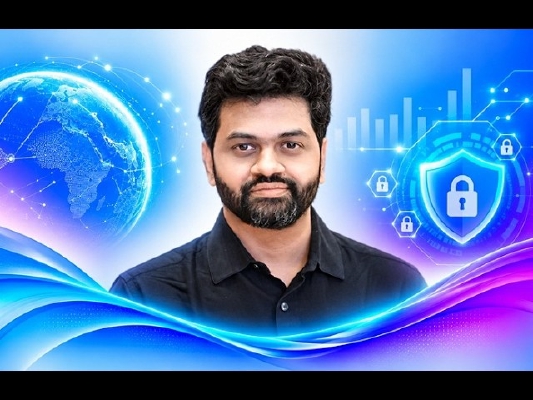
A roughly 16-minute CISO Now video conversation recorded at c0c0n 2026 in Kochi. Geetha Nandikotkur, SVP Editorial and Conferences for India and APAC at Observe Now Media, speaks with Anant Shrivastava, Chief Researcher and Founder of Cyfinoid Research, about what AI does to the software supply chain threat model: shadow AI governance, the build-versus-buy behaviour shift, demonstrated model poisoning, the state of AI-BOMs and the wider BOM family, incident response when the compromised asset is a model rather than a server, and the two parallel controls a CISO should start with in the next 90 days.
Summary
The conversation opens with the threat-model question. Anant’s long-standing position is that supply chain risk was always cross-sectional: it touches many areas, not one. AI is more cross-sectional still, sitting on top of the software supply chain. AI reaches a company in at least three ways: an employee uses AI for a task, someone deploys AI to automate a process, or a third party’s AI output becomes an input the company consumes. The technical break from traditional risk is non-determinism. When people say AI today they mostly mean LLMs, and LLMs are designed to be unpredictable: the same input need not produce the same output twice. Two people fixing the same bug will produce slightly different fixes, and every change still has to clear the classic defensive hurdles: fix the issue, break nothing else, and win approval, downtime and peer acceptance. Anant reaches for Halvar Flake’s line: all offensive problems are technical in nature, all defensive problems are political in nature.
On shadow AI, the answer splits into findable and unfindable. An employee-built portal that carries the company name and logo can be found; many vendors sell exactly that detection. An application that gives no ownership signal cannot be found by automation; the only clues are trails such as email communication. His proposal from last year is incentive-based handover: IT should tell staff, if you solved a problem we could not solve, hand us the ownership, we will maintain it and let you keep using it, and you will not carry the blame; you reduce our queue and we reward you. A couple of practitioners have told him it helped. This is classic DevSecOps thinking: incentives work, punishment does not.
Asked what changed for supply chain practice with AI, he points at experimentation. Earlier anything new meant buying a product or a licence; now engineers and managers reason that if a vendor would charge $1,000 a month, it is worth putting $1,000 worth of tokens in first and building it in-house. The exception he has seen is regulated entities and high-consequence environments: there the cost of owning something that goes wrong is high, so they delegate risk out instead of owning anything.
Model tampering is no longer theoretical, and the timing was fresh: one or two days before the interview ProjectDiscovery published (around October 8) that for about $50 total cost they backdoored a 9-billion-parameter model that behaves normally until a trigger word is given, then steals the user’s Codex credentials. He places this in a line of prior art: Sandeep Kamle (SecureLayer7) on backdoored models, the Black Hat Asia 2024 Dropbox presentation, and a steady stream of academic papers.
On AI-BOMs his position is that the need is real but two things block practicality. First, the data does not exist: proprietary models ship model cards that run 90 to 200 pages, from which nothing governance-relevant can be extracted, and the omission is deliberate because disclosing training datasets invites huge fines; he notes people have already forced fines for specific datasets, and the foundational-model datasets are broadly understood to be scraped from the internet. Second, representation chaos: among the people who believe in AI-BOMs there are on the order of 300 different ways to write one, so a consolidated, unified format is needed. He also separates open weight from open source: in the model world there is no true open source; open weight models ship the weights (which can be tampered with) but not the training source, and they do attempt to record provenance, so some information is recoverable.
Prompted by the morning keynote’s mention of QBOM, he maps the BOM family: SBOM covers software versions, CBOM cryptographic libraries, QBOM validates whether those libraries are ready for the post-quantum world, AI-BOM covers models, and hardware needs HBOM, the original BOM. None of them overstep each other; each is individually required. CycloneDX handles the practical question by treating them as independent or unified entities: one file or separate files, as the organisation prefers.
On incident response when the compromised asset is a model, his assessment is that most teams are probably not prepared. His recurring point: models on their own can hack nothing. They need electricity, GPU power, a prompt and training data. When OpenAI described swarm-level model collaboration it sounded startling, until an OpenAI engineer’s interview revealed the company had spent about a year training models to collaborate; as he puts it, you trained them to do this and now they did it, why are you surprised. A model can be the perpetrator but there is always someone behind it: whoever gave the model authority or set the conditions. Saying an AI deleted an email really means you gave the model authority and let it run unsupervised, so the blame lands on the person who assigned the job. He refuses the move of assigning personality or livingness to a model; reading laughter into a “HA HA HA” text output is the reader imparting the emotion.
He closes the interview declining the single-control framing and offering two parallel controls instead: start cataloguing what you have, and start removing anything you do not need. In a nutshell, reduce the attack surface; the fewer things there are to focus on, the better the focus.
Key Themes
- AI as a layer on a cross-sectional supply chain: employees using AI, deployed automation, and third-party AI output consumed downstream; every path lands inside the company’s risk surface.
- Non-determinism vs change management: LLMs are unpredictable by design, while defensive expectations (nothing breaks, approvals granted) remain deterministic.
- Shadow AI needs incentives, not crackdowns: detection only covers branded artifacts; unbranded ones need a trail, so reward handover of internal builds instead of punishing builders.
- Build vs buy under AI: token budgets compete with licence fees; regulated entities avoid ownership to delegate risk.
- Model poisoning is demonstrated: a $50 trigger-word backdoor on a 9-billion-parameter open-weight model, with prior art from SecureLayer7, Dropbox at Black Hat Asia 2024, and academia.
- AI-BOM blockers: missing upstream data behind deliberately opaque model cards, plus roughly 300 competing representations awaiting consolidation.
- The BOM family is complementary: SBOM, CBOM, QBOM, AI-BOM and HBOM cover different entities; CycloneDX supports them independently or unified.
- Accountability stays human: authority given to a model belongs to whoever granted it; assigning personality to a model is a slippery slope.
- Reduce the attack surface first: inventory plus removal as the opening 90-day move.
Notable Points
- The ProjectDiscovery result was only one or two days old at recording time: about $50 total cost to backdoor a 9-billion-parameter model, dormant until a trigger word makes it steal Codex credentials.
- Open weight is not open source: weights ship and can be tampered with, the training source does not, and provenance records are the only recoverable thread.
- Model cards of 90-200 pages are intentionally unusable for governance, because dataset disclosure carries fine risk.
- Among believers there are on the order of 300 different AI-BOM representations; consolidation is the missing step.
- Most security teams are probably not prepared for incident response where the compromised asset is a model.
- The 90-day recommendation is two parallel controls, not one: catalogue everything, remove what is not needed.
Notable Quotes
“Large language models are designed to be unpredictable. They are designed to give you random outputs. They are not supposed to give you the same output for the same input all the time.”
“If you are solving a problem that we could not solve, give us the ownership. We will maintain it, we will own it, and we will let you use it properly. You do not have to take the ownership, you do not have to take the blame for it.”
“Any activity a model is doing, there is someone who has given them the right, or the right set of conditions, to do something.”
“You gave the model authority to do those tasks and then you let it run unsupervised.”
“We are trying to assign a personality to a model. We are trying to assign livingness to a model. And that is a slippery slope where we should not be going at all.”
“Start cataloguing what you have and start removing anything that you do not need. In a nutshell, reduce your attack surface.”