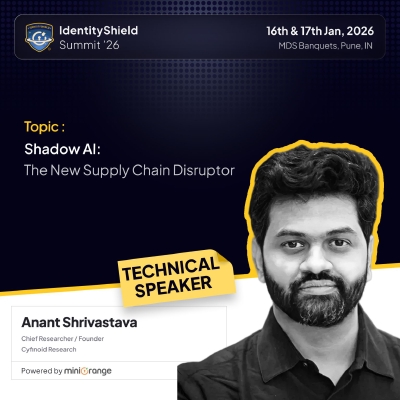
Presented at Identity Shield in Pune, “Shadow AI: The New Supply Chain Disruptor” addresses Shadow AI as the newest and most disruptive force in software supply chain security. The deck examines how the rapid proliferation of AI tools across organizations, often adopted without IT oversight, creates a new class of shadow technology intersecting with traditional shadow IT risks. It covers the changing landscape, the various forms of shadow technology, the production implications, risk classification frameworks for Shadow AI, and a governance approach using both incentives (“carrots”) and enforcement (“sticks”) to bring unsanctioned AI usage under organizational control.
Summary
The talk opens with the premise that the world has changed: AI adoption has fundamentally changed how software is developed, deployed, and consumed, and the pace of change means traditional governance and security models are unable to keep up with how AI tools are being adopted across organizations. Before diving into AI specifically, the deck establishes the flow everyone needs to know about how software now moves from idea to production, then widens the lens to shadows of all kinds: Shadow AI exists alongside other shadow technology categories such as Shadow IT (unsanctioned infrastructure), Shadow Data (unmanaged data flows), and Shadow SaaS (unauthorized cloud services). AI tools amplify all existing shadow categories by making it easier for anyone in the organization to build, deploy, and expose applications and services.
The production section examines what this means downstream: Shadow AI tools can introduce unvetted code, models, and dependencies into production environments; without governance, AI-generated outputs may bypass code review, security testing, and compliance checks; and the security team may not even be aware of AI tools being used, let alone what they produce. The deck then assesses current approaches and finds them insufficient: existing methods for handling Shadow IT (blocking, monitoring, policy enforcement) are not keeping pace with the speed and diversity of AI tool adoption, because traditional security controls were designed for a world where only technical staff built and deployed software.
The response framework starts with inventory as the foundation: discovering and cataloging AI tools in use across the organization is the essential first step, since without inventory organizations cannot assess risk, enforce policy, or respond to incidents involving AI-generated artifacts. On top of inventory sits an operational loop of continuous discovery, assessment, classification, and remediation that must operate at the speed of AI adoption, not at the pace of traditional IT governance. Discovery works through multiple angles: network traffic analysis, endpoint monitoring, procurement and expense tracking, SSO/identity federation logs, and direct team engagement.
The classification section introduces a structured framework for categorizing Shadow AI risks by severity and impact, enabling proportional response rather than blanket prohibition. The governance model then balances carrots and sticks: prohibition alone drives Shadow AI further underground, so organizations need to provide sanctioned alternatives that meet user needs; the carrot is approved AI tools, training, and support that make the sanctioned path easier than the unsanctioned one, while the stick enforces policy through access controls, monitoring, and consequences for non-compliance. The incentive loop creates a positive feedback cycle where sanctioned AI usage is easier, faster, and better supported than shadow alternatives, so users who adopt sanctioned tools get better support, more features, and organizational backing.
The closing message asks the audience to relook at their role: security and identity professionals must evolve from gatekeepers blocking AI adoption to enablers who provide secure, governed AI pathways. The goal is not to stop AI usage but to make it visible, assessed, and managed.
Key Themes
- The changing world: AI adoption has fundamentally changed how software is developed, deployed, and consumed. The pace of change means traditional governance and security models are unable to keep up with how AI tools are being adopted across organizations.
- Shadows of all kinds: Shadow AI exists alongside other shadow technology categories: Shadow IT (unsanctioned infrastructure), Shadow Data (unmanaged data flows), and Shadow SaaS (unauthorized cloud services). AI tools amplify all existing shadow categories by making it easier for anyone in the organization to build, deploy, and expose applications and services.
- Production implications: Shadow AI tools can introduce unvetted code, models, and dependencies into production environments. Without governance, AI-generated outputs may bypass code review, security testing, and compliance checks, and the security team may not even be aware of AI tools being used, let alone what they produce.
- Current approaches are insufficient: Existing methods for handling Shadow IT (blocking, monitoring, policy enforcement) are not keeping pace with the speed and diversity of AI tool adoption. Traditional security controls were designed for a world where only technical staff built and deployed software.
- Inventory as the foundation: Discovering and cataloging AI tools in use across the organization is the essential first step. Without inventory, organizations cannot assess risk, enforce policy, or respond to incidents involving AI-generated artifacts.
- Operational loop and discovery angles: Governance runs as a continuous discovery, assessment, classification, and remediation cycle, operating at the speed of AI adoption rather than the pace of traditional IT governance. Discovery vectors include network traffic analysis, endpoint monitoring, procurement and expense tracking, SSO/identity federation logs, and direct team engagement.
- Shadow AI risk classification: A structured framework categorizes Shadow AI risks by severity and impact. Classification enables proportional response rather than blanket prohibition.
- Incentives and enforcement (carrots and sticks): Prohibition alone drives Shadow AI further underground, so organizations need to provide sanctioned alternatives that meet user needs. The carrot: approved AI tools, training, and support, making the sanctioned path easier than the unsanctioned one. The stick: enforce policy through access controls, monitoring, and consequences for non-compliance.
- Incentive loop: A positive feedback cycle makes sanctioned AI usage easier, faster, and better supported than shadow alternatives. Users who adopt sanctioned tools get better support, more features, and organizational backing.
- Rethinking your role: Security and identity professionals must evolve from gatekeepers blocking AI adoption to enablers who provide secure, governed AI pathways. The goal is not to stop AI usage but to make it visible, assessed, and managed.
Notable Points
- Takeaway: start with inventory; discover what AI tools are actually being used across your organization through network monitoring, endpoint analysis, expense tracking, and identity/SSO logs.
- Takeaway: classify Shadow AI risks using a structured framework; not all Shadow AI usage carries the same risk, and proportional responses are more effective than blanket bans.
- Takeaway: provide sanctioned AI alternatives that are genuinely useful; if the approved tools are harder to use than unsanctioned ones, Shadow AI will persist regardless of policy.
- Takeaway: build a continuous operational loop where discovery, assessment, classification, and remediation run at the speed of AI adoption, not traditional IT governance cycles.
- Takeaway: use both carrots and sticks: incentivize sanctioned AI usage through better support and capabilities while enforcing policy through monitoring and access controls.
- Takeaway: evolve your security role from gatekeeper to enabler; the organizations that govern AI usage effectively will be those that make secure AI adoption the path of least resistance.
- Takeaway: recognize that Shadow AI is a supply chain problem: unvetted AI tools introduce unknown dependencies, unreviewed code, and unassessed models into your organization’s software supply chain.
Notable Quotes
“The flow we all need to know”
“Shadow’s of all kind”
“Inventory the systems”
“Carrots and Sticks”
“Relook at your role”