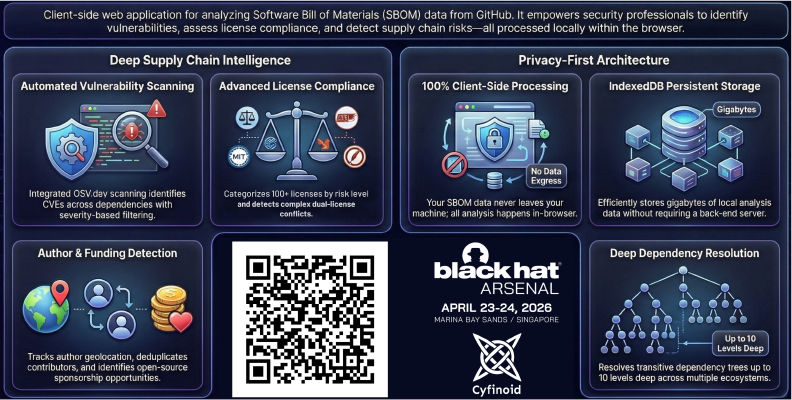
The Black Hat Asia 2026 Arsenal demonstration (Marina Bay Sands, Singapore, 24 April 2026) walks through SBOM Play, an SBOM exploration and intelligence extraction platform that runs entirely in the browser. The session is delivered as a live demo from the tool’s GitHub Pages deployment, framed by its origin story: a 2023 “Beyond the Code” argument that SBOMs are not the entire scope of the supply chain ecosystem, a 2024 round of “fad or future” conference talks, a first Python implementation, and the 2025 browser rewrite shown here. The pitch is that SBOMs have value well outside vulnerability tracking, and that showing beats telling.
Summary
The demo begins with inputs. SBOM Play accepts a GitHub organization, username, repository or org/repo pair, or a direct SBOM upload in SPDX or CycloneDX JSON. The GitHub path requires dependency graph to be enabled on the repositories. The architecture is the core design decision: everything is client-side, HTML and JavaScript only, with no backend. The tool can be downloaded as a zip and run by double-clicking index.html, and every request goes from the user’s browser directly to the data source with no middleman. Air-gapped use is supported through an allowlist of the endpoints the tool needs. A GitHub token is optional and needs no permissions at all; a blank token exists purely to lift rate limits.
Analysis resolves the SBOM dependency tree ten levels deep and queries multiple ecosystems in parallel before presenting a dashboard: repository counts, dependency counts, vulnerabilities, licenses, authors needing sponsorship, security issues and the ecosystem split. Two dashboard highlights get called out: most commonly used dependencies across the analysed estate, and version sprawl, where multiple versions of the same package are in use at once.
The walkthrough then covers each view. The license tab surfaces license changes between versions, verified live against package registries: wordwrap moving from an MIT/X11 pairing at 0.2 to plain MIT at 0.3, and es6-symbol moving from MIT at 3.1.1 to ISC at 3.1.3. The point is not legal judgement but visibility: something changed, and someone should look. The vulnerability tab lists classic issues with advisory links and fix directions, and, critically, the full dependency-tree path showing how a transitive component connects back to a repository in use. The audit tab scores uploaded SBOMs against minimum-element baselines such as BSI and CSAF 2025, listing what is missing, for example dependency relationships or component hashes.
The findings tab is the heaviest computation and, in the demo, reports 131 findings: seven potential dependency-confusion cases where package URLs could not be found on the registry, 112 packages with no release in three or more years flagged as potential end-of-life, plus a probable end-of-life band at two years, unpinned GitHub Actions referencing version tags instead of SHAs, and mutable tag references. The dependency view filters live and transitive dependencies by end-of-life status, maintenance state, minor or major version drift, sponsorship needs and vulnerability. The authors view aggregates maintainers across all analysed repositories, ranks them by impact, plots available locations on a map, and surfaces social links and sponsorship pages.
Settings close the loop: dependency depth, parallelism, batch size and API timing are tunable, and a configurable sanctioned-countries list filters authors by geography for supply-chain due diligence. Scans are exportable and importable, a cached relational database can be exported separately from raw SBOM data, and debug tooling covers cache management. Everything lands in IndexedDB on the user’s machine.
Key Themes
- Show, don’t argue: the tool exists to demonstrate SBOM usefulness beyond the security industry’s vulnerability focus, with a live demo replacing screenshot slides.
- Client-side by design: no backend and no middleman; the tool runs from a downloaded zip and keeps air-gap use realistic through a documented endpoint allowlist.
- SBOMs as an intelligence base: licenses, versions, authors and lifecycle signals become queryable once SBOM data is aggregated.
- Change over time is the signal: version-to-version license changes and version sprawl only become visible when multiple repositories are analysed together.
- Lifecycle risk in numbers: abandoned packages, dependency-confusion candidates, unpinned actions and mutable tags surface as concrete counts.
- People are part of the graph: author aggregation, geography and sponsorship status turn a dependency tree into a maintainership map.
Notable Points
- Inputs: a GitHub org, user, repo or org/repo pair (dependency graph enabled), or direct SPDX/CycloneDX JSON upload.
- An optional GitHub token needs no permissions at all; a blank token is enough to avoid rate limiting.
- Dependency resolution walks ten levels deep and queries ecosystems in parallel; depth and parallelism are configurable in settings.
- The demo findings tab reported 131 findings: seven potential dependency-confusion cases and 112 packages with no release in three or more years.
- License changes were verified live on package registries: wordwrap 0.2 (MIT/X11) to 0.3 (MIT), and es6-symbol 3.1.1 (MIT) to 3.1.3 (ISC).
- The audit tab compares SBOMs against minimum-element baselines including BSI and CSAF 2025 and lists missing fields such as dependency relationships and component hashes.
- Unpinned GitHub Actions (version tags rather than SHAs) and mutable tag references are flagged as findings because they can change underfoot.
- The authors view ranks maintainers by impact on the analysed estate, maps available locations, and links sponsorship pages.
- A configurable sanctioned-countries list filters authors by geography; the demo used CN, IN and GB as placeholder entries and then cleared them.
- History per the talk: a Python first version in 2024, the browser rewrite in 2025; results persist in the browser’s IndexedDB.
Notable Quotes
“It’s far better to show rather than just to talk.”
1:27
“We go 10 levels deep.”
3:38
“There’s no back-end that can be used here. It’s all HTML and JavaScript.”
4:45
“Just a blank GitHub token is good enough.”
5:20
“There are 112 potential end of life.”
11:47
“We don’t know which country is our enemy, which country is our friend.”
15:10
“Everything gets stored in the index DB, and everything is client side.”
18:17