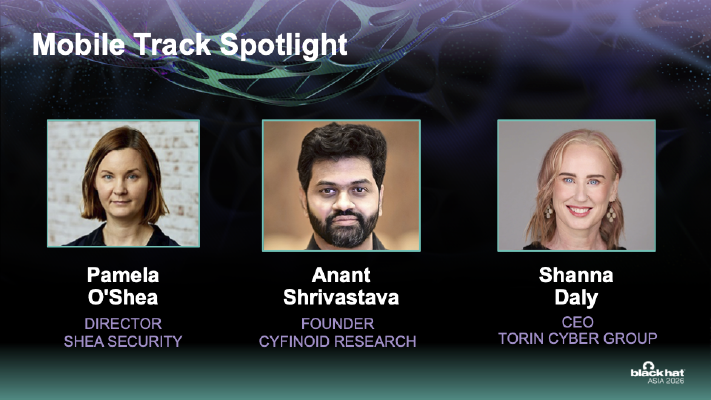
At Black Hat Asia 2026 (Marina Bay Sands, Singapore, April 24, 2026), the Mobile Track Spotlight panel brought three Mobile Track review board members on stage for a candid, audience-driven discussion on the state of mobile security. Anant Shrivastava, founder of Cyfinoid Research working in mobile software supply chain and cloud security, moderated, introducing panelists Shanna Daly (Sydney; runs Torren Cyber Group, specializing in digital forensics, incident response, and SOC work) and Pamela O’Shea (Melbourne; a pentest company specializing in mobile testing, web testing, and code review). With no prepared slides, the session ran on audience questions plus a few backup filler questions, covering AI-generated code bloat, hardware-backed security, jailbreak detection economics, AI-driven offensive research, and how practitioners should actually learn mobile security.
Summary
The format was a track spotlight: all three speakers judge the Black Hat Asia Mobile Track review board, the session ran with no slides on audience questions, and it alternated between offensive and defensive viewpoints on AI-generated code, hardware-backed security, jailbreak detection economics, and how to learn mobile security. Anant’s recurring thesis: mobile apps run in hostile territory 100% of the time, so design for compromise rather than trying to detect it.
On AI-generated code, Pamela reported code bloat growing across her pentests, and mobile is unique because the app lives on the phone: eventually developers must claw back AI code bloat, because more code means more to review. Pamela mostly sees normal React apps across platforms, while Anant sees PWA traction declining in favor of installed apps; a unified codebase ships the same bug everywhere, and React is very hard to reverse from a black-box perspective, hence the plea to give pentesters the source code.
On AI in pentesting, Pamela has deliberately kept AI from running the whole job, using it for pattern coverage on large codebases while humans hunt authentication and authorization logic and the weird code paths nobody tries. Anant’s analysis: LLMs excel at low-hanging fruit because their knowledge is huge for documented problems but stall on undocumented business logic, and the prerequisite is the task IT hates most, writing good documentation. Asked whether AI has found genuinely good offensive mobile attacks, the panel noted stop-start flows like payments and facial recognition that resist automation, and Anant judged the best automation engine on Android is still Monkey, which just sends random click events.
On hardware-backed security, the panel discussed secure enclaves, StrongBox, and Android’s secure element being reachable only through OEMs; Pamela saw hardware heading in a great direction while the radio side stays very messy and very old. On jailbreak detection, OWASP ASVS treats the controls as optional, and Anant framed security as an economic decision about not securing 10 rupees with 20,000; over-engineered SSL pinning fails in practice because a shopping app pinning to certificate hashes would need updates every 90 days that users will not install.
On compromise detection, Pamela called it a question of how much time you want an attacker to spend bypassing, so it comes down to threat appetite, while Anant argued for assuming compromise: Play Integrity and iOS precautions can all be bypassed, so validate server-side, which is why client-server dominates mobile apps and why games that skip it drown in mods and modified APKs. The session closed with a one-tip-each round covering OWASP’s mobile testing guides, building and decompiling a trivial app, compiling LineageOS or GrapheneOS, and MobSF as an offensive starting point.
Key Themes
- Assume the device is hostile: Mobile apps run in enemy territory 100% of the time, so put validation and trust on the server side instead of trying to detect compromise.
- Size security to the asset: Jailbreak detection and certificate pinning are optional per ASVS, applying only when the data justifies the cost, and real users never update their apps.
- AI is a coverage tool, not a replacement: Let it handle documented, repetitive layers so humans hunt business-logic flaws, but only good documentation makes even that possible.
- AI code bloat hits mobile harder: The app lives on the phone, so unbounded generated code must eventually be clawed back, and more code means more to review.
- Hardware is improving, radio is not: Secure enclaves and containerized chip functions raise the bar, while the baseband side remains messy, old, and full of research territory.
- Implementation beats protocol: Echoing the event’s car security talk, protocols are rarely the problem; their implementations are.
- Learn by building and breaking: Build a trivial app and decompile it, compile LineageOS or GrapheneOS, run MobSF against an APK, and get good at web first.
Notable Points
- All three speakers sit on the Black Hat Asia Mobile Track review board, and the session ran with no slides on audience questions.
- Pamela’s dominant trend report: lots of AI-generated code, with mobile facing a limit that web does not because the app lives on the phone.
- Anant reported declining PWA traction in favor of installed apps, with Hermes improving React Native performance.
- Anant’s API example: an endpoint with five functions where one rarely-used function has a weak description stalls an LLM beyond the first parameter or two.
- The previous day’s boot ROM talk was cited as excellent, and the radio or baseband side was called very messy and very old.
- Over-engineered SSL pinning fails operationally: pinning to hashes would force updates every 90 days that users will not install.
- Google Play Integrity and iOS precautions can all be bypassed, so a game’s high score should be validated server-side on every update.
- Games that skip the client-server model are the ones drowning in mods and modified APKs.
- Anant’s learning blueprint: OWASP MSTG and MASVS, build a trivial app in Android Studio or Xcode and decompile it including smali, study API documentation, then compile LineageOS or GrapheneOS at the OS layer.
- Recommended starting resources: Pentester Lab and Hack The Box for web-first skills, the Google SDK documentation for architectural intuition, and MobSF to see what it flags in an APK or IPA and work out why. Anant’s joke alternative: let Claude Code hallucinate something and spend two days figuring out how it works.
Notable Quotes
“Help out your pentesters and give them the source code, please.”
4:21
“…we have to do exactly the one thing anyone in IT hates: write good documentation.”
6:59
“You don’t secure 10 rupees with 20,000. You always secure assets with things that are less costlier than the assets themselves.”
11:10
“Your app is running in a hostile territory 100% of the time.”
9:40
“I think the best automation engine on Android is still Monkey, which basically does not have any sense of what it is doing. It just sends random click events.”
14:18
“Don’t save anything here. It’s really hostile out there.”
10:40
“It’s all about your threat appetite.”
15:40
“If I have to understand something, I have to build it piece by piece.”
21:57